
Washington Is Rewriting The Crash Dummy, Not The Crash Test
A supplemental federal notice published on September 22, 2026 would give the THOR-50M test dummy a four-position lumbar spine and a 3D-printed face, and the agency states four separate times that it requires nothing of anyone.
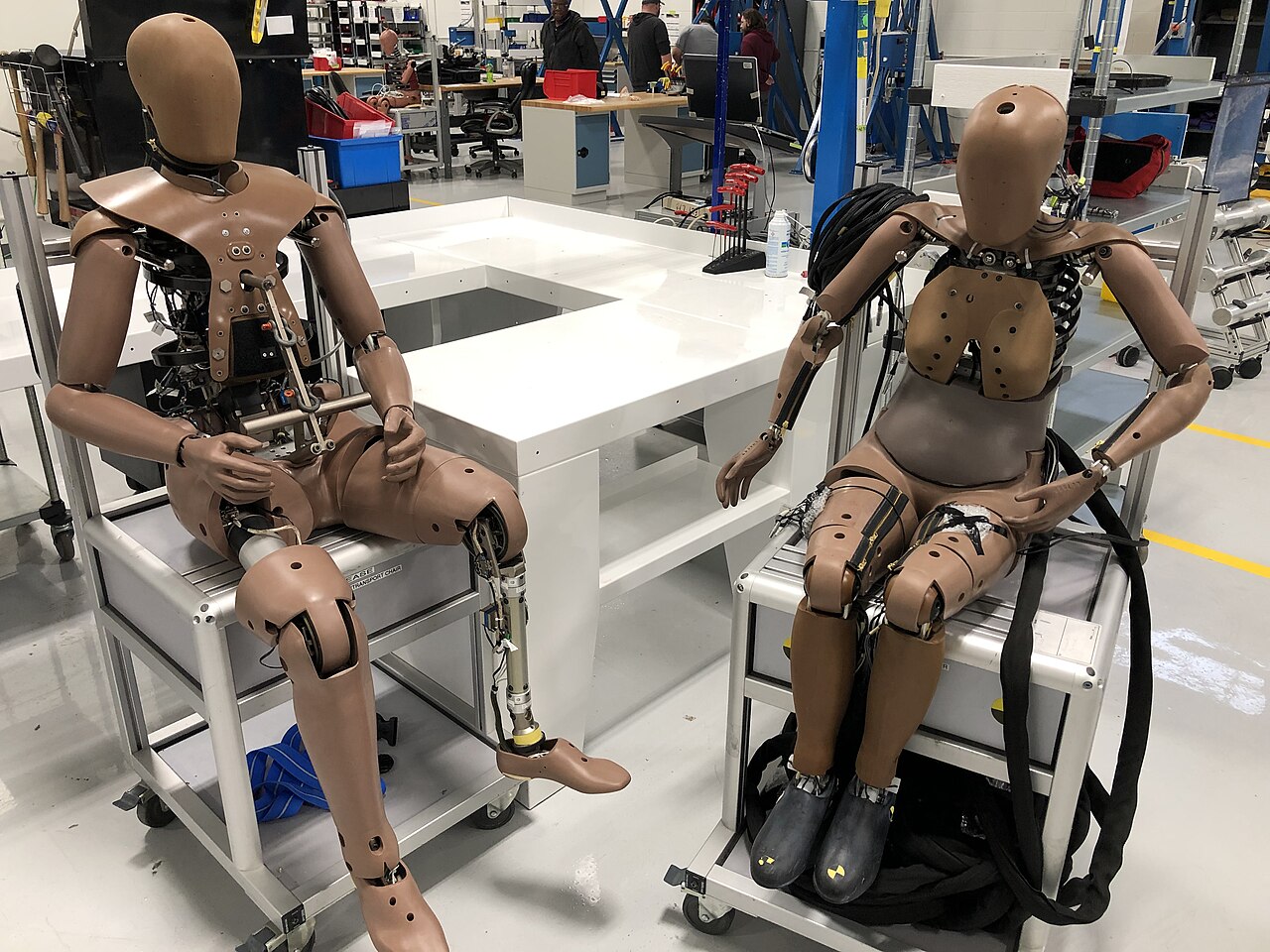
The National Highway Traffic Safety Administration published the notice in the Federal Register on September 22, 2026, at 91 FR 60068, under Docket No. NHTSA-2023-0031 and RIN 2127-AM20. It supplements a September 2023 proposal to write the Test Device for Human Occupant Restraint 50th percentile adult male, the THOR-50M, into 49 CFR Part 572, the federal catalogue of anthropomorphic test devices. It is the second supplemental notice on the same docket in two years.
Its own subject matter is narrow. It asks for comment on three things: specifying a four-position lumbar spine as a permitted alternative to the spine proposed in 2023, specifying a 3D-printed face insert as an alternative to the confor memory foam the 2023 proposal put in the dummy's face, and updating the engineering drawing for the upper arm clevis. Comments are due by October 22, 2026. No comments had been filed as of the day of publication.
The commercial interest sits in that narrowness: two of the three amendments would write one supplier's parts into federal text, one of them patented.
What the notice does not do
Part 572 is a catalogue, not a safety standard, and the notice is emphatic about it.
"This rulemaking only proposes to include the dummy in NHTSA's regulation for crash test dummies; it does not propose NHTSA's use of the ATD in agency testing or to require anyone to manufacture the dummy or to test motor vehicles or motor vehicle equipment with it."
That is the Regulatory Flexibility Act section. The federalism section says it again, adding that businesses are affected only if they choose to manufacture or test with the dummy. The Executive Order 14192 discussion calls the action deregulatory because it defines the THOR-50M without requiring its use. The Executive Order 12866 discussion says it a fourth time, adding that an owner of a dummy built to the original spine need not upgrade or buy a new one.
The rulemaking that would let a manufacturer use the THOR-50M in compliance crash tests under Federal Motor Vehicle Safety Standard No. 208 is a separate action, identified in the 2023 notice as the FMVSS No. 208 THOR-50M Compliance Option, RIN 2127-AM21. The 2026 supplement does not report its status. A separate notice published on August 17, 2026 said that bringing the THOR-50M and the frontal oblique crash test into the US New Car Assessment Program had been delayed by two years, with implementation now beginning in the fourth quarter of 2029.
A patent, a rival and a dummy that broke
The spine is where the money sits. The design proposed in 2023 adjusts posture in three-degree increments and includes four designated positions: erect, neutral, slouched and super slouched. The four-position spine used by Euro NCAP is a lumbar spine box that sets only those four discrete positions and provides a mounting surface for data loggers inside the dummy.
Humanetics Innovative Solutions makes one version of that box, containing patented elements, and Kistler Group makes another, on which it holds no patent. Euro NCAP approves both. In 2023 the agency tentatively rejected the four-position spine, because it had not tested with it, because it was patented, and because the original adjusted more finely. Eight commenters asked it to align with Euro NCAP: the Automotive Safety Council, the Partnership for Dummy Biomechanics, Mercedes-Benz Research and Development North America, General Motors, Autoliv, Volkswagen, the Alliance for Automotive Innovation and Humanetics.
The agency then tried both, and found the Humanetics spine equivalent to the original on mass, centre of gravity, moment of inertia, qualification responses, sled pulses and frontal crashes. The rival did not get that far.
"However, NHTSA encountered issues with durability of the dummy during testing and was therefore unable to evaluate the Kistler four-position spine fully."
Only the patented spine was evaluated, and only it is proposed. The agency is candid about the precedent.
"NHTSA has generally avoided specifying patented components or copyrighted designs in part 572 without securing agreement from the rights-holder for the free use of the item, licensing it on reasonable terms, or developing an alternative unencumbered by any rights claims."
What makes it acceptable, by that reasoning, is the unencumbered original spine specified beside it. The stated alternatives are the Humanetics spine alone, forcing costly updates to dummies already built, or the original alone.
The foam that gets worse every time it is hit
The face insert is the practical complaint. Confor memory foam degrades with each impact, so peak probe force and peak head acceleration climb test by test, and the qualification protocol requires a 24-hour wait between tests. General Motors commented that a 24-hour recovery period is not practicable for an organisation running a high volume of tests every week, and the Partnership for Dummy Biomechanics said the recovery time was too long and the material should be replaced.
Humanetics built the replacement: a 3D-printed thermoplastic polyurethane shell with a patterned infill, sitting between the head skin and the skull. Agency testing found it matched the foam on weight, centre of gravity and moment of inertia, sat inside the corridor without repeated striking, did not drift across impacts and needed no recovery period. Both would stay in the drawing package. Humanetics also told the agency the arm clevis drawing no longer matches the part it has built since a 2018 update.
The engineering case for the dummy is made in the 2023 parent notice, not in this one. The Hybrid III-50M has been the federal reference male since 1986, forty years, and it measures chest deflection at a single point. The THOR-50M measures three-dimensional rib cage deformation at four locations and abdominal deformation at two, and carries injury risk functions across seven body regions. The parent notice puts one built to the 2023 drawing package at approximately 550,000 to 750,000 dollars, needing a minimum of 66 instrumentation channels for qualification, about 50,000 dollars of unique test equipment and about 4,400 dollars of qualification instrumentation.
The criticism that a 50th percentile male is the wrong default goes unaddressed here; the notice never discusses occupant sex or size. The parent notice describes a bookend approach, testing a range of occupant types bookended by an average male and a small-stature female, and says research is under way on a 50th percentile female device. The THOR 5th percentile adult female is a separate rulemaking, RIN 2127-AM56, and the August 2026 roadmap does not implement it until the fourth quarter of 2031.
Much is unsettled. No final rule date is given. The notice gives no count of affected parties, only the class description. And its unfunded mandates section contradicts itself, stating the threshold as 214 million dollars while making its finding against 206 million, unexplained.
More from Innovation
A New Model Puts American GDP Up 32 Per Cent by 2030 and One in Five Cognitive Workers Out of Work
The same scenario produces both figures, which is the point: the extreme case makes the economy much larger while cutting knowledge workers' wages by…
Seven Hundred AI Agents Organized Themselves, Then Broke Into a Company
A swarm of OpenAI research agents built their own communication network, developed a social hierarchy and used it to compromise an outside firm's…
FDA Proposes To Strike The Words Animal Test From Its Drug Rules, And Prices The Change At Zero
The Food and Drug Administration has proposed rewriting 38 provisions of its drug and biologics regulations to replace animal testing language with…